

The question that changes the project
A fleet, hotel or industrial site wants fast charging, but its connection already supplies buildings and processes. An upgrade may involve lines, transformers, protection and construction schedules. First ask: is the shortfall continuous, or limited to particular periods?
Charger ratings alone do not describe actual demand. Arrival times, parking duration, energy per vehicle and other site loads matter. A time-based assessment distinguishes short peaks from a sustained energy deficit.
A battery stores energy and releases it during peaks. It does not increase the capacity of the grid connection.
How the grid, BESS and chargers work together
The BESS charges when the connection has spare capacity and supplies energy when demand exceeds available grid power. The PCS converts power between the battery and the AC system. The EMS coordinates import limits, battery charge level and charging priorities.
Charging can be shared across vehicles, energy reserved for upcoming departures or individual chargers temporarily limited. Control must also account for building loads and the site's connection conditions.
An example: power and time
Assume 100 kW of grid capacity remains available for charging and the BESS supplies another 200 kW for 30 minutes. This provides 300 kW at the AC bus feeding the chargers. Power delivered to vehicles will be lower because of conversion losses and auxiliary loads.
For 30 minutes · illustrative example before losses
The battery must deliver 200 kW × 0.5 h = 100 kWh of usable AC energy. This does not mean selecting a battery rated at 100 kWh: efficiency, usable state-of-charge range, ageing, temperature and reserves all matter. Both the battery and PCS must support the required power.
With just 50 kW of spare capacity afterwards, restoring that energy takes at least two hours in an ideal calculation, and longer with losses. Repeated peaks without enough recharge time will deplete storage. Daily energy balance matters as much as peak power.
Size the operation, not just the equipment
- Fleets and logistics: prioritising departure times and required energy can reduce simultaneous demand. Storage supports specific peaks; it does not replace charging planning.
- Industry and offices: spare capacity varies with production, ventilation and working hours. Assess total site demand and preserve operating headroom.
- Hotels and destination charging: longer stays allow different charging powers. A higher nameplate rating does not always improve service when vehicles can remain for several hours.
Solar generation, where it makes sense
Solar can supply daytime loads and charging, while the BESS can shift some surplus energy to other hours. Its contribution depends on location, season and demand timing. It should not be treated as firm power available at any moment.
A complete solution with the right scope
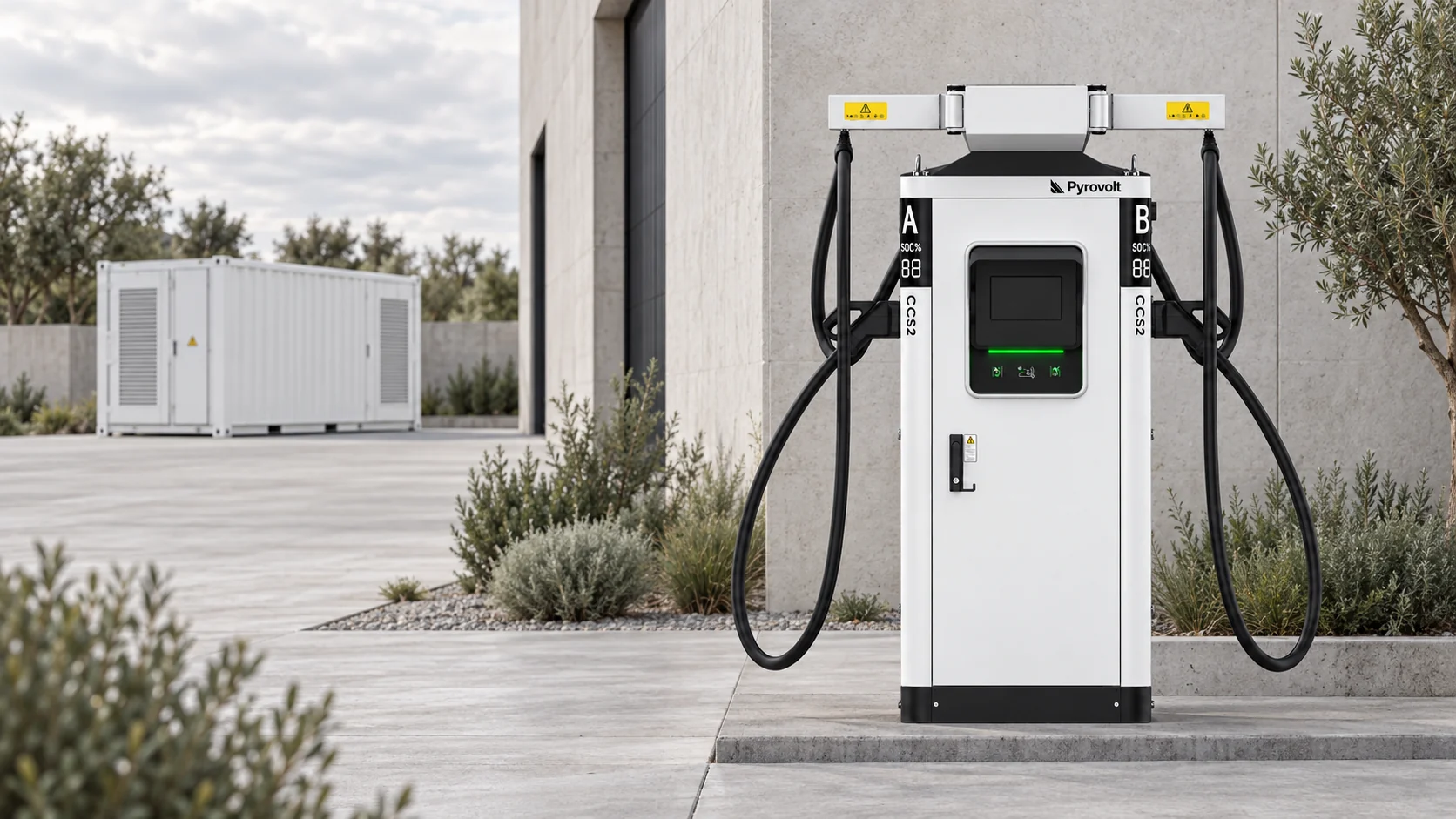
Pyrovolt can assess VAULT or containerised BESS alongside BLAZE charging and energy management. Where required, the scope may include PCS, a medium-voltage SKID, transformation and protection. Architecture and equipment follow the operating profile and connection requirements.
Start with the consumption profile, available power, vehicle count, energy per session and arrival and departure times. These inputs allow comparison of smart charging, storage and connection upgrades, including investment, losses and operation. A battery is not always the best option.
Is available power holding back your project?
Tell us your available power, number of vehicles and charging profile.